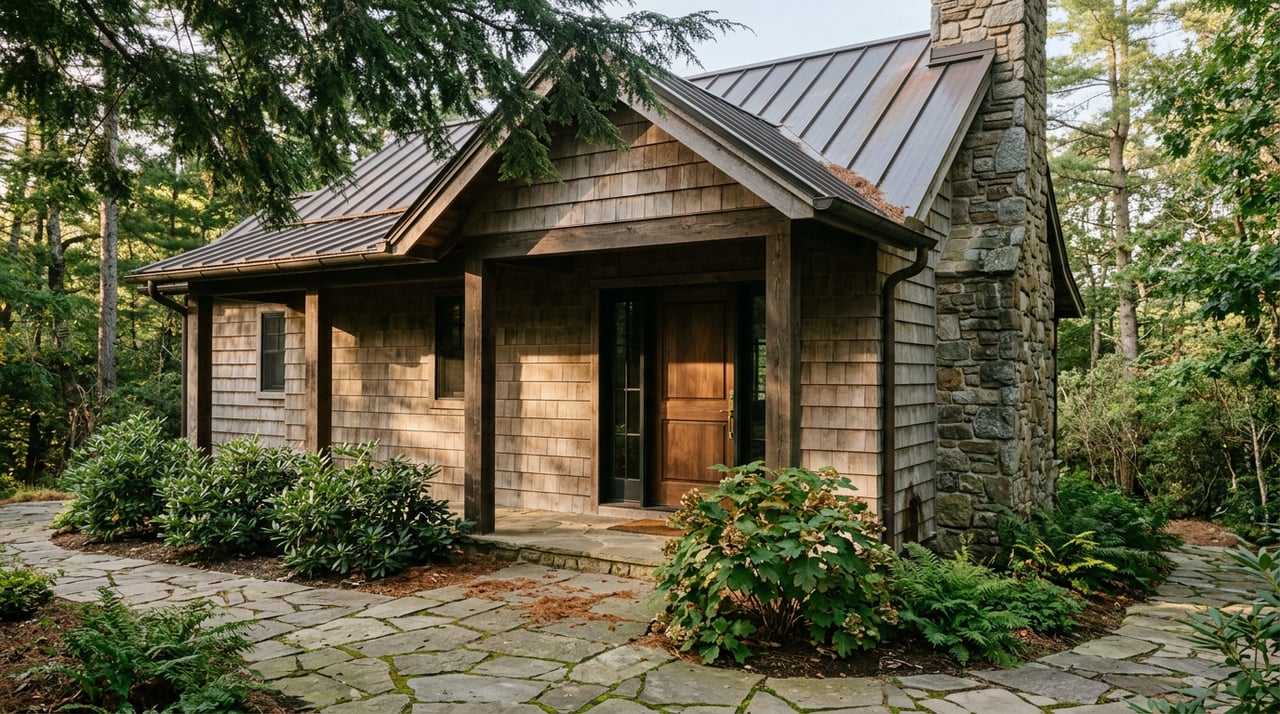
Drive along Railroad Avenue in Mineral Bluff on an ordinary Tuesday and the old depot looks like every other small-town rail building left standing after the trains moved on: a low frame structure with a deep eave, the kind of thing you assume is either boarded up or turned into someone's weekend project. Most people keep driving. What they miss is that the building is doing almost exactly what it was built to do in the first place, just at a scale you could fit in a shoebox.
The depot is the headquarters of the Tri-State Model Railroaders, a north Georgia club that has spent years building a museum-quality HO-scale layout inside the station. The layout is not a generic model railroad. It reconstructs the actual L&N line as it ran from Atlanta to Etowah, Tennessee, including the branch that connected Blue Ridge and Mineral Bluff to Murphy, North Carolina, modeled around 1950. The building that once dispatched real trains along that route now houses a working replica of it. That is not a coincidence a town this size gets twice.
Why There Was Ever a Depot Here at All
Mineral Bluff's whole reason for existing traces back to water, not lumber or farmland. At the turn of the century the town was known for mineral springs said to be the best in the region, and when the railroad arrived, it brought visitors by the trainload to soak in them. Those turn-of-the-century arrivals built summer homes and settled into a social season built around the baths. As the crowds around the mineral springs faded, Mineral Bluff became a crossroads community rather than a resort destination.
What is worth noticing is how little of that boom-era town actually survives in physical form. An old church on the corner is still in use. The post office still operates out of one of the historic structures. And the depot still stands on Railroad Avenue, one of the few original buildings from Mineral Bluff's rail-and-springs era that has not been converted into a private home or quietly demolished. It survived by staying useful, first as a functioning train station, now as a clubhouse for people who care enough about that history to model it down to the rivet.
Two Weekends to Actually See It
The depot is not open every day, but this fall it has two dates that turn it from a building you drive past into a building you can walk into.
| Event | Dates | Hours | What It Is |
|---|---|---|---|
| Ride the Rails | October 24 to 25, 2026 | Trips on the hour, noon to 3 p.m. both days | The club's own open house, with rides through the layout on the hour |
| Piedmont Pilgrimage | November 14, 2026 | 10 a.m. to 1 p.m. | A single stop on a regional tour of more than 60 model railroad layouts across north Georgia and metro Atlanta |
The two events are shaped differently on purpose. Ride the Rails belongs entirely to Mineral Bluff. It is the club's own weekend, run at its own pace, with volunteers walking visitors through the layout and running trains on the hour for anyone who wanders in off Railroad Avenue. The Piedmont Pilgrimage is something else: a single Saturday morning when the depot becomes one entry on a much longer list, part of an annual tour that spans everything from N scale to G gauge across dozens of layouts in the region. For three hours that November morning, a building in a town most GPS apps barely register becomes a stop on a map that also includes model railroads in metro Atlanta. Admission to both events is free.
What the Depot Says About the Rest of Mineral Bluff
It would be easy to read the depot as a nostalgia act, a small museum keeping a hobby alive in a building whose original role has changed. That reading misses the more interesting fact underneath it. Mineral Bluff did not disappear when the mineral baths lost their draw; its role changed, while its railroad history remained part of the community. The depot still brings people together around that history, with the original route running in miniature and local volunteers keeping it in motion. The town today is not a preserved version of its boom years. It is a continuation of the same place, still organized loosely around that original rail crossing, still running on volunteer energy rather than tourist traffic.
That distinction matters if you are trying to understand what living in Mineral Bluff actually feels like day to day, separate from how it gets described in a listing. This is not a town built for constant activity. It is a town where one of this fall's public events is three hours of model trains on a Saturday morning, and where the people who show up for it are neighbors rather than visitors passing through. The depot is not an attraction dressed up for outsiders. It is one of the last original buildings in town, kept alive by people who live here and decided it was worth the effort.
If you already live in Mineral Bluff, the depot is worth the ten-minute detour from wherever you are on either of those two weekends, if only to see the branch line to Murphy running the way it once actually did, just smaller than you remember it ever being.
If you are further along in thinking about property in this pocket of Fannin County, whether that is a full-time move or a second home near the water and the mountains, this is the kind of texture that does not show up in a listing sheet but shapes what it is actually like to live here. Laura Elleby and the E+E Group work this stretch of North Georgia because they know it at this level of detail, from the depot on Railroad Avenue to the lake a few miles south. Discover Blue Ridge living, and let's talk about your next move.